Was Napoleon really short?
The short answer
No. When his doctor examined his body in May 1821, he wrote down just over 5 feet 2 inches in old French units. That is about 1.69 m, or 5 ft 6 in.
Frenchmen of the next generation, the men who filled his armies, averaged about 1.64 to 1.65 m. So he was average or slightly above. The "little" Napoleon grew out of British cartoons from 1803, long before the measurement usually blamed for the myth.
His height, measured
His doctor, François Antommarchi, examined the body on St Helena on 6 May 1821, the day after Napoleon died. Item 4 of his findings gives the height from the top of the head to the heels: "cinq pieds deux pouces et quatre lignes". He printed it in his memoirs in 1825 (tome 2, p. 158).
Those are the old French royal units, and each was bigger than its English namesake:
- 5 pieds × 32.48 cm = 162.4 cm
- 2 pouces × 2.71 cm = 5.4 cm
- 4 lignes × 0.23 cm = 0.9 cm
- Total: 168.7 cm, or 5 ft 6.4 in
Other records give much the same height:
| Who | When | What they wrote | Height (cm) |
|---|---|---|---|
| Painters Joseph Farington and Benjamin West, by eye (Farington's diary) | 1802 | Farington: "not more than 5 feet 6"; West: 5 ft 7 (English feet) | 168 or less; 170 |
| General Gourgaud, at Napoleon's request, on the ship to St Helena (journal, p. 58) | 8 Sep 1815 | 5 pieds 2½ pouces | 169.2 |
| Gourgaud again, against a door on St Helena (journal, pp. 259–260) | Aug 1817 | 5 pieds 2 pouces "français" | 167.8 |
| Antommarchi, after his death (memoirs) | 6 May 1821 | 5 pieds 2 pouces 4 lignes | 168.7 |
| Constant, his valet (memoirs, tome 2, p. 53) | published 1830 | 5 pieds 2 pouces 3 lignes | 168.5 |
At that door in 1817, Madame Bertrand, wife of his grand marshal, measured about 1.74 m. She was taller than the Emperor.
Where "five foot two" came from
"Five foot two" is the French number read as if it were English. A French inch (pouce) was about 2.71 cm; an English inch is 2.54 cm. So five French feet and two French inches come to about five feet six in English.
Some popular articles say this mix-up is partly why he is remembered as short (National Geographic). The post-mortem figure cannot be how the idea began. British cartoonists were drawing him tiny from 1803, eighteen years before it.
English readers were even given the conversion. The London translation of Antommarchi's book (we checked the 1826 edition) prints the figure with a footnote: "French measure", about five feet six (vol. 1, pp. 102–103). The mix-up may have helped keep the idea alive, but the cartoons came first.
"Little Boney"
The small Napoleon was made in British print shops. In 1798 the caricaturist James Gillray still drew him at an ordinary size (Public Domain Review). Then, in 1803, as the peace of 1802 fell apart, Gillray's prints shrank him:
- "German Nonchalence; or, the Vexation of Little Boney", 1 January 1803. The earliest "Little Boney" print we found (record).
- "Maniac-raving's, or, Little Boney in a strong fit", 24 May 1803. Napoleon in a rage, chair and globe knocked over (Yale).
- "The King of Brobdingnag, and Gulliver", 26 June 1803, designed by Thomas Braddyll and etched by Gillray. King George III studies a tiny Napoleon through a spyglass (British Museum).
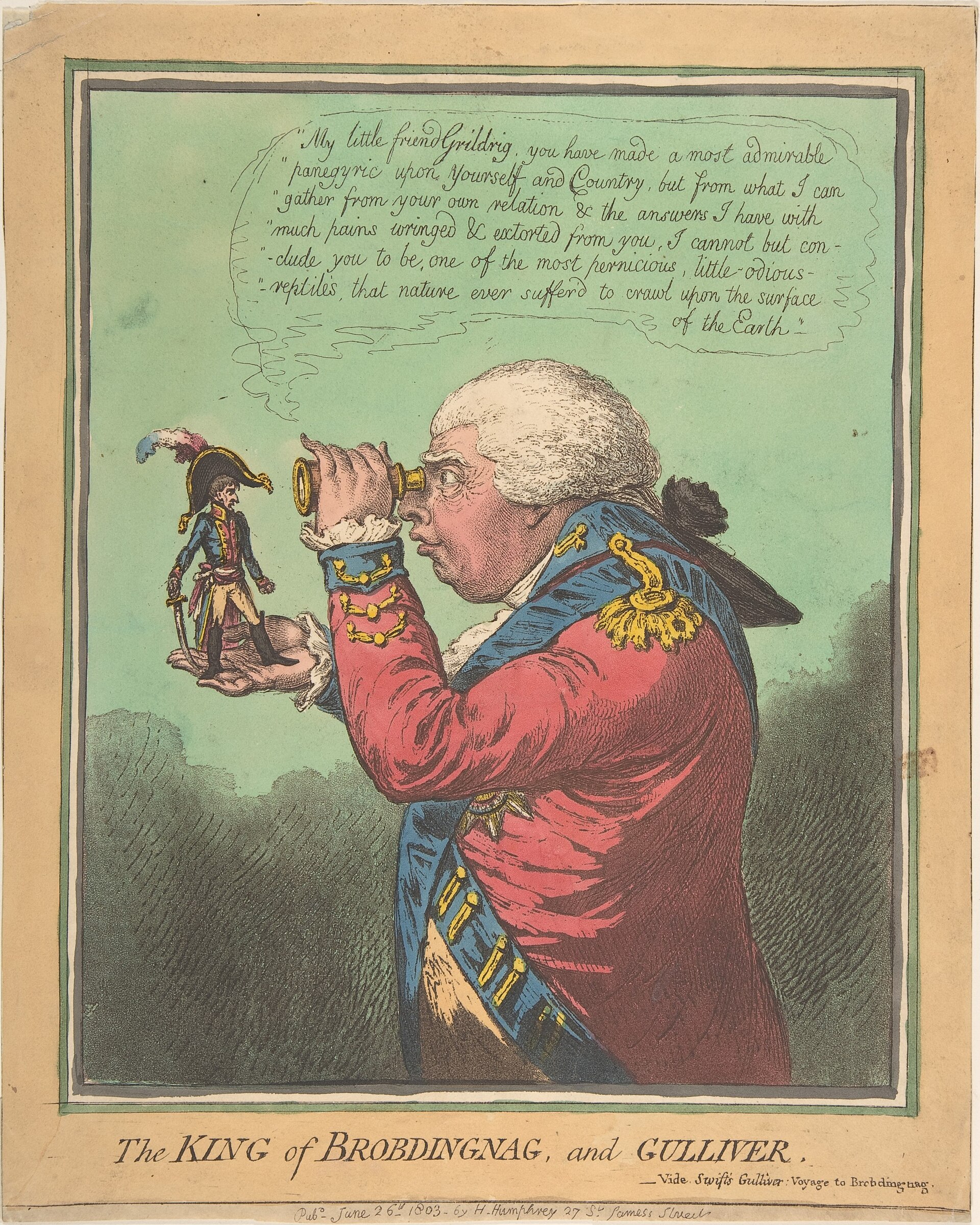
The historian Marcel Dunan, writing in 1963, blamed the "little Boney" legend on British propaganda after the peace broke down (study).
Why he could look short
His Guard. From 1804, a grenadier of the Imperial Guard was meant to be at least 1.78 m, and he wore a tall bearskin cap. In practice the rule bent. Grenadiers of the 1st regiment who joined in 1810–12 averaged about 1.75 m, and nearly 60 percent were under the minimum (Dawson). Beside them, Dunan argued, a slight man in a plain colonel's uniform could look smaller.
His nickname. His soldiers called him "le petit caporal", the little corporal. Tradition ties it to the battle of Lodi in 1796 and to a general who was close to his men (Fondation Napoléon). We found no document linking it to his height, or using it in 1796.
What is documented, and what is still open
Documented: the post-mortem figure (printed 1825), Gourgaud's two measurements (from his day-by-day journal) and the dates of the Gillray prints.
Estimated: average height. Scholars rebuild it from conscription records: about 1.64 to 1.65 m for Frenchmen born in the 1780s to 1800s (Komlos and others; Weir). They have no estimate for men born before the 1780s, including his own year, 1769.
Still open:
- Whether the inch mix-up mattered at all. Popular articles say it did. We found no historian who shows it happening.
- Who held the measuring rule in 1821. Dunan says Napoleon's valet Marchand helped. We have not seen Marchand's memoir.
- The "5 ft 7 in" from his funeral. Dunan read it as his height. In the upholsterer Andrew Darling's journal it is the inside length of the coffin, not a measurement of his body (journal).
- The "Napoleon complex". The idea that short men overcompensate has an unclear origin, and the few studies of it are mixed (Knapen and others, 2018).
Sources
Written at the time
- Antommarchi, Mémoires du docteur F. Antommarchi, Paris, 1825, tome 2, p. 158
- Antommarchi, The Last Days of Napoleon, London, 1826, vol. 1, pp. 102–103
- Gourgaud, Sainte-Hélène: journal inédit, tome 1, p. 58, and tome 2, pp. 259–260
- Mémoires de Constant, Paris, 1830, tome 2, p. 53
- Andrew Darling's journal of the funeral, Fondation Napoléon
- First-hand descriptions of Napoleon, including Farington's diary, Napoleon Series
The prints
- Gillray, "German Nonchalence; or, the Vexation of Little Boney", 1 January 1803: Sheffield record, British Museum
- Gillray, "Maniac-raving's, or, Little Boney in a strong fit", 24 May 1803: Yale, British Museum
- Gillray after Braddyll, "The King of Brobdingnag, and Gulliver", 26 June 1803: British Museum, RISD Museum
Studies
- Marcel Dunan, "La taille de Napoléon", Revue de l'Institut Napoléon no. 89, 1963
- Peter W. Walker, "Little Boney", Public Domain Review, 2024
- Pierre Branda, "Avant-propos du livre Napoléon et ses hommes", Fayard, 2011
- Paul Dawson, "Grognards: Grenadier à Pied de la Garde 1799–1815", Napoleon Series
- Komlos, Hau and Bourguinat, "An Anthropometric History of Early-Modern France", 2003
- David Weir, "Economic Welfare and Physical Well-Being in France, 1750–1990", 1997
- Knapen, Blaker and Van Vugt, "The Napoleon Complex: When Shorter Men Take More", Psychological Science, 2018
- Erin Blakemore, National Geographic, 22 November 2023
This article is human-led: people on our team picked the topic, set the direction and approved every word. AI helped us research, draft and check.